
What Divided Government Has Meant for the Markets
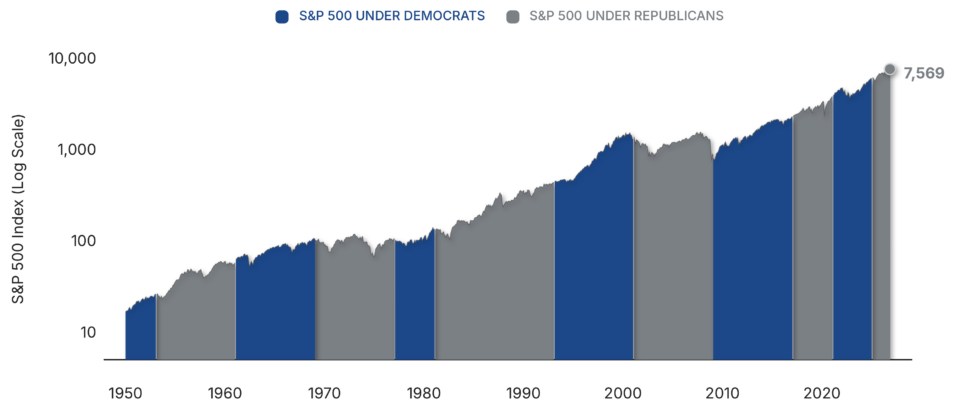
We’ll start with the long view: over decades, U.S. companies have found ways to create shareholder value regardless of which party controls Washington.
S&P 500 Price Under Democrats and Republicans
Elections can move markets for a day or a week, but in general they should not drive long-term investment policy. We maintain our philosophy and long-term outlook for the portfolios that we manage. With that context, here is our summary of the election results and their likely implications for investors. We’ll note that, given how quickly markets are moving, figures cited here are as of the morning of November 4th and may have since changed.
Democrats won control of both the House and the Senate on November 3rd, ending a unified Republican government and setting up two years of a Republican White House facing a Democratic Congress. For investors, the headline is not about policy reversals so much as a policy freeze. New fiscal stimulus is probably off the table, President Trump keeps his veto power and his executive tools on trade, and we see the main new risks as budget brinkmanship (the debt limit will likely be reached by mid-2027), oversight fights (including over AI) and a slower path for AI, crypto and data-center build-outs.
Stocks: Reaction & History
The market’s initial reaction was mildly bumpy but settled quickly. Overnight, S&P 500 futures and Nasdaq-100 futures both dipped, led by AI names. By morning, however, both had flipped to modest gains led by Dow futures, while gold also rose.
Historically, we have seen:
- 12 Months after a Midterm: the S&P 500 has averaged a 15.2% 12-month return measured from Election Day (1950–2023), versus 7.3% in all other years. It has not posted a negative 12-month return after any midterm since at least 1950.
- Six Months after a Midterm: across the last 14 midterms, the S&P has averaged a 15.5% gain in the first six months following Election Day, with the first month averaging +1.7%.
Why have we seen such strong returns shortly after the midterm election? Election uncertainty clears, and gridlock lowers the odds of sweeping tax or regulatory change. In other words, we know what type of political environment we will have for the next two years, meaning less change is expected.
It’s important to be aware that averages hide volatility. During President Trump’s first term, when Democrats flipped the House in the 2018 midterm election, the S&P 500 fell about 8% from Election Day until the end of the year before rebounding solidly in 2019, with total return +32%. Additionally, the current market backdrop is less friendly than usual with: the 10-year Treasury near 5%, Brent oil at about $104/barrel on the Iran conflict and an AI trade that is now facing uncertainty over a possible slowdown in the AI data-center build-out.
Bonds & the Deficit
Gridlock may be mildly good for long-term Treasuries because it takes new deficit-financed stimulus off the table, but it raises the risk of debt-limit drama in 2027. Treasuries initially rallied on the results and have since settled near where they started.
The $5,000 checks to every adult that President Trump floated if Republicans kept control of Congress are now off the table, removing a significant potential addition to the deficit. However, deficits are still running large at around $2 trillion, or about 6.5% of annual GDP. The gridlock could slow or stop new spending, but it does not shrink the spending we have already locked in.
The debt limit, which is expected to be hit in mid-2027, will likely be the Democrats’ biggest source of leverage with President Trump. Democrats may ask for things such as restoring the ACA health insurance subsidies, reversing Medicaid cuts that took place in 2025 and limits on tariffs in exchange for raising the debt ceiling.
What It Means for Portfolios
Republicans keep control of Congress until January 3rd, 2027, when the new members are sworn in. Until then, we could see the current Congress try to raise the debt limit, extend funding or confirm nominees. What happens during this time may remove some uncertainty, along with some of the leverage Democrats might otherwise have in 2027.
Essentially, none of this impacts our approach. As the chart at the top shows, companies have kept building shareholder value under Democratic and Republican administrations alike, and over time, earnings, inflation and the Fed have mattered more to markets than who holds power in Washington. Divided government typically takes the largest fiscal surprises off the table, and stocks have historically done well in the year after a midterm. What Washington is likely to add over the next two years is a handful of deadline-driven scares, with the debt limit in 2027 the first big one. Long-term investors have historically been rewarded for looking through episodes like these rather than reacting to headlines, and we intend to do the same.
Please contact your Ancora team to discuss these or other topics further.