
The United States has crossed another milestone: more than $40 trillion in national debt. While that number is large enough to seem otherworldly, its effects are increasingly showing up in places that matter to investors and families. Higher government borrowing means more Treasury bonds must be issued to finance ongoing deficits. To attract buyers, those bonds often require higher interest rates, creating competition for capital and placing upward pressure on borrowing costs throughout the economy. The result is that mortgages, business loans and other forms of credit become more expensive, affecting everything from home purchases to economic growth.
U.S. Federal Debt Growth
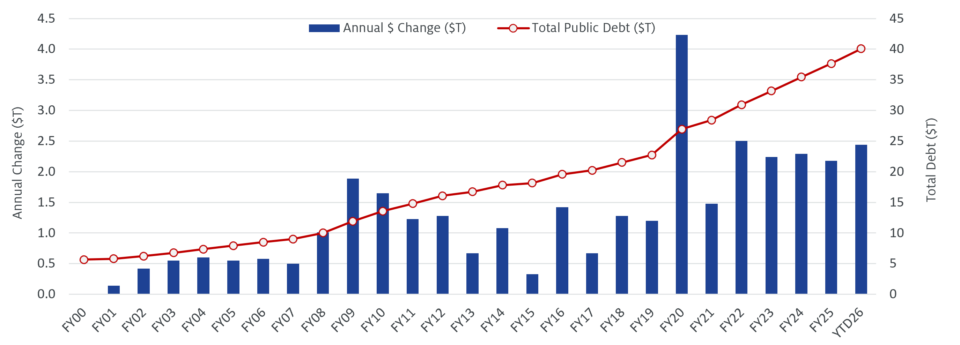
At first glance, a debt crisis might seem inevitable, but unlike a household or business, the federal government has tools that allow it to postpone the day of reckoning. The Federal Reserve can purchase Treasury securities, effectively creating new money that helps absorb government borrowing needs and maintain liquidity in the financial system. This ability means there is no obvious cliff where the United States suddenly “runs out of money.” Deficits can be financed for far longer than people might expect. However, avoiding a crisis is not the same as avoiding consequences.
Those consequences often emerge in the form of inflation. As more dollars are created to support growing levels of debt, the purchasing power of each dollar can gradually erode. Inflation is more than an economic statistic; it is a tax on savers. Over time, it becomes harder to increase real wealth, even when investment accounts show positive returns. The goal is not simply to make money, but to earn a real return, meaning a return that exceeds inflation and increases purchasing power.
That distinction matters because we see true financial freedom as being ultimately about options. It is the ability to allocate your human capital in the way that is most meaningful to you. For some, that means continuing to work because they enjoy it. For others, it means volunteering, spending more time with family, improving their health, strengthening relationships, exploring nature or pursuing personal passions. Inflation quietly steals some of that freedom by requiring more resources to maintain the same standard of living. If your savings fail to outpace inflation, the amount of time and effort required to support your desired lifestyle continues to increase.
So what do we do? Technology such as AI can play a role in future productivity gains, which is an offset to inflation, but it can’t erase existing debt. And the reality is that most of us cannot control government spending, deficits or monetary policy. What we can control is our response. That means saving consistently, investing thoughtfully, managing risk, controlling debt and maintaining a long-term financial plan. It means becoming more intentional with every financial decision because the margin for generating real returns has narrowed. In many ways, that is the shared cost of decades of sustained deficit spending. The challenge facing investors today is not simply growing wealth, but preserving purchasing power and maintaining the freedom to live life on your own terms. We are here to help.