
We’ll often have clients ask about differences in their returns compared to the markets, or why they don’t own more of certain big-name winners. Let’s look to factor investing to provide a useful lens for understanding what drives equity returns. The reality is that the markets constantly shift focus between chasing presumed winners (momentum) and rewarding fundamentals (quality), while a well-managed portfolio should do both, limiting over-exposure to any one market environment.
Ancora’s traditional portfolios are designed for longevity, which means they typically involve less risk, and therefore less movement, than the overall market. We have seen historically that disciplined long-term investing has led to strong risk-adjusted returns over time. It’s this discipline that keeps investors from chasing the “hot stocks” that typically involve more risk, and therefore more movement. By extension, that means there will (and, we would argue, should) often be visible short-term differences in returns between the markets and a long-term portfolio.
Quality and momentum are among the most important—and often most debated—factors. Both have delivered long-term outperformance relative to the broader market, yet they behave very differently across market cycles, macro regimes and sentiment environments. The past two years have offered a particularly stark illustration of this divergence, with momentum surging ahead while quality delivered steadier, more measured gains.
Factor investing in equities is an investment approach that targets specific, measurable characteristics, called factors, that have historically been associated with higher risk-adjusted returns. Instead of picking individual stocks based purely on discretionary judgment, factor investing systematically weights stocks according to attributes over time. Some of the most widely studied factors include: value, growth, momentum, quality, size (small-cap, mid-cap, large-cap) and (low) volatility.
Momentum focuses on price trends. We know historically that stocks that have performed well recently tend to continue to outperform in the near term (typically measured by 12-month price return, excluding the most recent month). They are rewarded with strong price trends, regardless of underlying fundamentals.
Quality focuses on fundamentals. These are companies with strong profitability, stable earnings, strong balance sheets and durable competitive advantages, like high return on equity, stable earnings growth, strong free cash flow generation and low financial leverage. Quality stocks tend to be defensive in nature, holding up better in downturns but often lagging in risk-on rallies.
A Divergence in Returns
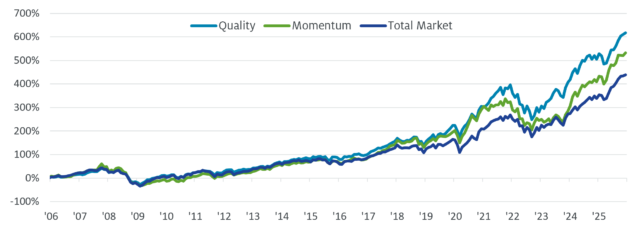
Over the very long run, quality has demonstrated a structural advantage in consistency. Over the 20-year period ending December 31, 2025, quality stocks returned a cumulative 613.57%, outperforming momentum stocks, which returned a cumulative 528.57%. Both factors have outperformed the broader market, which returned a cumulative 436.42% during that same time period. Quality has outperformed momentum in 62.5% of annual rolling five-year periods through December 31, 2025, and outperformed the broader global equity market in every single rolling five-year period.
Momentum vs. Quality Cumulative Returns: 2006-2025
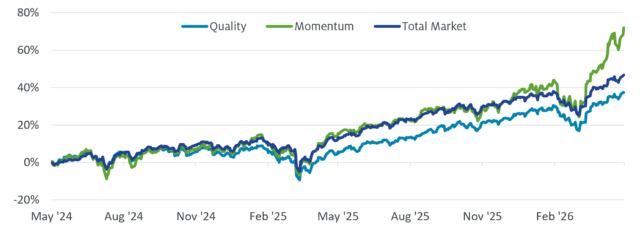
The short-to-medium term picture, however, tells a starkly different story from the long-term performance. Over the two years ending May 26, 2026, momentum stocks have delivered a cumulative return of 72.00%, nearly double that of quality stocks, which returned 37.32%. The total market has returned 46.72% during that same time period.
The gap began to widen in late 2024 as the AI trade really started to take effect. In 2025, the market’s appetite for quality waned, leading to a valuation de-rating for such stocks, while stocks with strong price momentum were favored instead, driving an even wider divergence from quality stocks as investors heavily favored the technology sector.
Momentum vs. Quality Cumulative Returns: 2-Year*
What is driving the divergence? Several macro and market forces explain momentum’s recent dominance:
- AI-driven concentration: The artificial intelligence investment cycle created powerful, self-reinforcing price trends in a narrow set of large-cap technology and semiconductor names — precisely the environment where momentum thrives. Chipmakers and AI-linked stocks were among the standout performers in both 2024 and 2025.
- Risk-on sentiment: Broadly positive risk appetite rewarded recent winners and penalized the defensive characteristics embedded in quality portfolios, reflecting a shift in investor demand toward more speculative AI-linked exposures.
- Tariff shock and volatility: The April 2025 tariff shock created a sharp but short-lived drawdown for both factors. Momentum, however, recovered more aggressively as markets rebounded, while quality’s defensive characteristics provided only a modest cushion during the dislocation.
Momentum’s outperformance has come at a valuation cost. High-momentum stocks are trading at over three times the valuation of their low-momentum counterparts on a price-to-sales basis, with the median price-to-sales ratio for top-quintile momentum stocks at 4.19x compared to 1.32x for the bottom quintile. Quality, meanwhile, has historically sat at the most extreme valuations of any factor — but recent de-rating has made it comparatively more attractive.
The performance of each factor is highly regime-dependent:
- In low-inflation, lower-rate environments, momentum has historically delivered average excess returns of 18.7%, compared to 12.3% for quality.
- In higher-rate, inflationary environments, quality’s defensive characteristics become more valuable, and the gap narrows significantly — momentum’s excess return falls to 4.0% versus quality’s 9.0%.
- Momentum is particularly vulnerable to “momentum crashes” — i.e., sharp, sudden reversals that occur when crowded trades unwind. The probability of such crashes is reduced in low-inflation, lower-rate conditions.
Portfolio Construction: Complementary, Not Competing
The key insight we take away for our portfolio construction philosophy is that momentum and quality are not mutually exclusive; they are complementary. Momentum captures trend and sentiment; quality provides a fundamental anchor. A balanced approach combining both factors can offer diversification and improve the risk-adjusted return of a portfolio, which is typically Ancora’s approach for traditional, long-term portfolio construction, dependent on client needs.
With momentum valuations stretched and quality having de-rated meaningfully, the relative attractiveness of quality is improving. For investors with a longer time horizon, quality’s track record of outperforming across full market cycles, and in every rolling five-year period versus the broad market, remains a compelling argument for an investor to maintain exposure to the quality bias with a healthy portion of their portfolio.
Momentum, by contrast, remains a powerful tactical tool in trending, risk-on markets, but requires active monitoring of crowding, valuation, and macro regime shifts that can trigger rapid reversals and lead to increased volatility.